
The health of medically fragile infants is our highest priority.
Learn more about The Milk Bank’s safety standards, accreditation, and screening processes.
Every step of our process is designed to ensure the highest standards of safety, quality, and transparency. Our protocols include several critical layers of protection:

Extensive Donor Screening
Our milk donors participate in a multi-step screening process, including a detailed health history, blood testing, and medical and lifestyle risk assessment. This screening is modeled after FDA, blood, and tissue donation standards.

Milk Pasteurization
All milk is pasteurized using the Holder method which destroys potential harmful pathogens while preserving key nutrients and immune properties.

Microbiological Testing
Each batch of Pasteurized Donor Human Milk (PDHM) is tested by a third party CLIA CAP accredited lab following pasteurization. Only PDHM that passes this safety check is dispensed.

Traceability & Documentation
Each bottle of PDHM is labeled with a unique barcode and tracked throughout its journey — from donor to recipient — ensuring full traceability and accountability.

FDA Compliance: Food Safety Plan
The Milk Bank is registered with the U.S. Food and Drug Administration, further ensuring that our processes meet national regulatory expectations.
Our Food Safety Plan is designed to identify and control potential risks at every step of milk handling and processing. Certified Preventive Controls Qualified Individuals (PCQIs) conduct verification and validation procedures to assess biological, chemical, and physical risks, and implement preventive controls to mitigate them.
Our food safety plan is continuously reviewed and refined to enhance the safety and quality of every product we dispense.
Donor Screening
Our donors are healthy, lactating mothers who undergo a rigorous screening process to ensure the safety of their milk. This screening meets or exceeds the standards set by the Human Milk Banking Association of North America (HMBANA), which were developed in consultation with the FDA, CDC, and blood and tissue banking experts.
The process includes:
- Completion of a comprehensive healthcare questionnaire
- Medical and lifestyle history verification
- Blood testing for HIV 1 & 2, HTLV 1 & 2, Hepatitis B & C, and Syphilis

Continuous Quality Improvement
We believe safety is not a static goal — it’s a constant commitment. Our dedicated team oversees all aspects of compliance, training, and operational improvement:

Staff Training & Certification
All team members receive regular training in safe handling practices, and current milk banking protocols.

Accreditation
The Milk Bank undergoes annual accreditation by the Human Milk Banking Association of North America (HMBANA) and adheres to their evidence-based safety and quality standards.

Audits & Oversight
Internal audits, process reviews, and quality assurance checks are conducted routinely. We provide comprehensive training for all staff in safe handling, aseptic technique, and quality control.

Data-Driven Decisions
Our team actively monitors batch safety data and processes to identify opportunities for innovation and improvement.
Why Use Pasteurized Donor Human Milk?
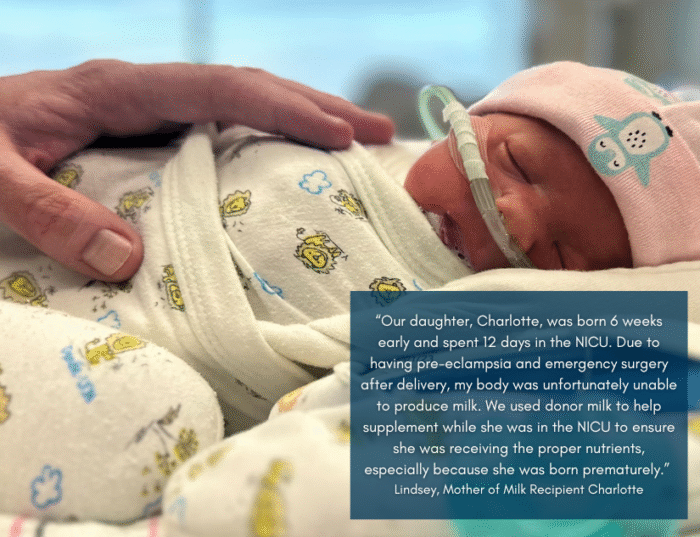
For premature and very low birth weight infants, breast milk is not only nutrition, but medicine. The American Academy of Pediatrics (AAP) recommends using Pasteurized Donor Human Milk (PDHM) as the preferred feeding choice when a mother’s own milk is not available.
Research has shown that the use of PDHM for supplementation or in entirety provides protection against Necrotizing Enterocolitis (NEC), an oftentimes fatal intestinal disease that impacts premature infants. PDHM is proven to modulate development of a preterm infant’s gut microbiome.
Is Donor Milk Safe? And Other Donor Milk FAQs
Yes. Donor milk from The Milk Bank is safe, screened, pasteurized, and tested. Every step of the process is designed to protect your baby—especially if they are medically fragile or premature. Our rigorous safety protocols ensure only high-quality milk is dispensed.
Milk donors are healthy, lactating parents who:
- Complete a detailed medical and lifestyle history
- Fill out a healthcare questionnaire
- Provide a blood sample that is tested for HIV, HTLV, Hepatitis B & C, and Syphilis
Only those who meet strict eligibility criteria are approved to donate.
All approved donor milk of The Milk Bank is:
- Pasteurized using the Holder method to destroy viruses and bacteria.
- Tested after pasteurization to ensure microbial safety.
- Tracked throughout its journey from donor to recipient.
Yes. The Milk Bank:
- Is accredited annually by the Human Milk Banking Association of North America (HMBANA).
- Follows guidelines developed in collaboration with the FDA, CDC, and experts from blood and tissue banking.
- Is registered with the FDA and committed to continuous quality improvement .
Our clinical team ensures that milk is dispensed according to a baby’s specific needs and their healthcare provider’s guidance. We follow strict handling and storage protocols whether milk is shipped to a hospital or dispensed to families through our outpatient programs.
Committed to Safety for
All We Serve
We work closely with hospitals, outpatient providers, and families to uphold a shared standard of safety and quality. Whether milk is delivered to a Level IV NICU or a family’s front door, it arrives with the same commitment: safe, high-quality human milk for the infants who need it most.